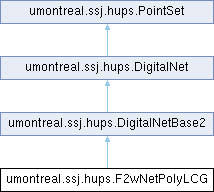
This class implements a digital net in base 2 starting from a polynomial LCG in \(\mathbb F_{2^w}[z]/P(z)\). More...
Public Member Functions | |
| F2wNetPolyLCG (int type, int w, int r, int modQ, int step, int nbcoeff, int coeff[], int nocoeff[], int dim) | |
| Constructs and stores the set of cycles for an LCG with modulus n and multiplier a. | |
| F2wNetPolyLCG (String filename, int no, int dim) | |
| Constructs a point set after reading its parameters from file filename; the parameters are located at line numbered no of filename. | |
| String | toString () |
| Formats a string that contains information on this digital net. | |
| Public Member Functions inherited from umontreal.ssj.hups.DigitalNetBase2 | |
| double | getCoordinate (int i, int j) |
| Returns \(u_{i',j}\), the coordinate \(j\) of point \(i'\), where \(i'\) is the Gray code for \(i\). | |
| double | getCoordinateNoGray (int i, int j) |
| Returns \(u_{i,j}\), the coordinate \(j\) of point \(i\), the points being enumerated in the standard order (no Gray code). | |
| PointSetIterator | iterator () |
| Returns a DigitalNetBase2Iterator which enumerates the points using a Gray code. | |
| PointSetIterator | iteratorNoGray () |
| This iterator does not use the Gray code. | |
| void | addRandomShift (int d1, int d2, RandomStream stream) |
| Generates a random digital shift for coordinates \(j\) from d1 to d2-1, using stream to generate the random numbers. | |
| void | addRandomShift (RandomStream stream) |
Same as addRandomShift(0, dim, stream), where dim is the dimension of the digital net. | |
| void | clearRandomShift () |
| Erases the current digital random shift, if any. | |
| void | leftMatrixScramble (int r, RandomStream stream) |
| This is a version of LMS in which each column of the lower-triangular scrambling matrix is represented as an integer less than 2^w, just like for Cj. | |
| void | leftMatrixScramble (RandomStream stream) |
| By default, the matrices L_j have r = w rows. | |
| void | iBinomialMatrixScramble (RandomStream stream) |
| Similar to leftMatrixScramble, except that all entries on any given diagonal or subdiagonal of any given \(\mathbf{M}_j\) are identical. | |
| void | stripedMatrixScramble (RandomStream stream) |
| Applies the striped matrix scramble proposed by Owen. | |
| void | rightMatrixScramble (RandomStream stream) |
| Applies a linear scramble by multiplying each \(\mathbf{C}_j\) on the right by a single \(k\times k\) nonsingular upper-triangular matrix \(\mathbf{M}\), as suggested by Faure and Tezuka. | |
| void | nestedUniformScramble (RandomStream stream, double[][] output) |
| Same as nestedUniformScramble(stream, output, 0) . | |
| void | nestedUniformScramble (RandomStream stream, double[][] output, int numBits) |
| Applies Owen's nested uniform scrambling to the digital net and returns the scrambled points in the two-dimensional array output. | |
| void | nestedUniformScramble (RandomStream stream, int[][] output, int numBits) |
| Same as nestedUniformScramble(RandomStream,double[][],int), but it returns the points as integers from 0 to 2^outDigits - 1, instead of doubles. | |
| void | leftMatrixScrambleDiag (RandomStream stream) |
| Similar to leftMatrixScramble except that all the off-diagonal elements of the \(\mathbf{M}_j\) are 0. | |
| void | leftMatrixScrambleFaurePermut (RandomStream stream, int sb) |
| Similar to leftMatrixScramble except that the diagonal elements of each matrix \(\mathbf{M}_j\) are chosen from a restricted set of the best integers as calculated by Faure [58] . | |
| void | leftMatrixScrambleFaurePermutDiag (RandomStream stream, int sb) |
| Similar to leftMatrixScrambleFaurePermut except that all off-diagonal elements are 0. | |
| void | leftMatrixScrambleFaurePermutAll (RandomStream stream, int sb) |
| Similar to leftMatrixScrambleFaurePermut except that the elements under the diagonal are also chosen from the same restricted set as the diagonal elements. | |
| void | iBinomialMatrixScrambleFaurePermut (RandomStream stream, int sb) |
| Similar to iBinomialMatrixScramble except that the diagonal elements of each matrix \(\mathbf{M}_j\) are chosen as in leftMatrixScrambleFaurePermut. | |
| void | iBinomialMatrixScrambleFaurePermutDiag (RandomStream stream, int sb) |
| Similar to iBinomialMatrixScrambleFaurePermut except that all the off-diagonal elements are 0. | |
| void | iBinomialMatrixScrambleFaurePermutAll (RandomStream stream, int sb) |
| Similar to iBinomialMatrixScrambleFaurePermut except that the elements under the diagonal are also chosen from the same restricted set as the diagonal elements. | |
| void | stripedMatrixScrambleFaurePermutAll (RandomStream stream, int sb) |
| Similar to stripedMatrixScramble except that the elements on and under the diagonal of each matrix \(\mathbf{M}_j\) are chosen as in leftMatrixScrambleFaurePermut. | |
| void | unrandomize () |
| Restores the original generator matrices and removes the random shift. | |
| void | resetGenMatrices () |
| Restores genMat to the original generator matrices. | |
| void | eraseOriginalGenMatrices () |
| Erases the original generator matrices and replaces them by the current ones. | |
| int[][][] | genMatricesToBitByBitFormat () |
| Returns the generator matrices as a 3-dimensional array of shape dim x numRows x numCols integers, one integer for each bit. | |
| void | genMatricesFromBitByBitFormat (int[][][] matrices) |
| Reverse of the previous function. | |
| void | printGeneratorMatrices (int s) |
| Prints the generating matrices bit by bit for dimensions 1 to \(s\). | |
| void | printGenMatrices (int s) |
| Prints the generating matrices in the standard format, one integer per column, for dimensions 1 to \(s\). | |
| void | printOriginalMatrices (int s) |
| Prints the generating matrices in the standard format, one integer per column, for dimensions 1 to \(s\). | |
| int[] | getGenMatrices () |
| Returns a copy of the generator matrices for dimensions 1 to \(s\). | |
| void | outputInterlace (int[][] points, double[][] interlacedPoints) |
| Interlaces the points from a digital net. | |
| DigitalNetBase2 | matrixInterlace () |
| Interlaces the matrices from a digital net. | |
| Public Member Functions inherited from umontreal.ssj.hups.DigitalNet | |
| DigitalNet () | |
| Empty constructor. | |
| int | getInterlacing () |
| Returns the interlacing factor. | |
| void | setInterlacing (int interlacing) |
| Sets the interlacing factor. | |
| void | resetGeneratorMatrices () |
| Restores the original generator matrices. | |
| void | eraseOriginalGeneratorMatrices () |
| Erases the original generator matrices and replaces them by the current ones. | |
| Public Member Functions inherited from umontreal.ssj.hups.PointSet | |
| int | getDimension () |
| Returns the dimension (number of available coordinates) of the points. | |
| int | getNumPoints () |
| Returns the number of points. | |
| void | randomize (PointSetRandomization rand) |
| Randomizes this point set using the given rand. | |
| void | addRandomShift (int d1, int d2) |
| Refreshes the random shift (generates new uniform values for the random shift coordinates) for coordinates d1 to d2-1, using the saved shiftStream. | |
| void | addRandomShift () |
Same as addRandomShift(0, dim), where dim is the dimension of the point set. | |
| String | formatPoints () |
Same as invoking formatPoints(n, d) with \(n\) and \(d\) equal to the number of points and the dimension of this object, respectively. | |
| String | formatPoints (int n, int d) |
| Formats a string that displays the same information as returned by toString, together with the first \(d\) coordinates of the first. | |
| String | formatPoints (PointSetIterator iter) |
Same as invoking formatPoints(iter, n, d) with \(n\) and \(d\) equal to the number of points and the dimension, respectively. | |
| String | formatPoints (PointSetIterator iter, int n, int d) |
Same as invoking formatPoints(n, d), but prints the points by calling iter repeatedly. | |
| String | formatPointsBase (int b) |
Similar to formatPoints(), but the points coordinates are printed in base \(b\). | |
| String | formatPointsBase (int n, int d, int b) |
Similar to formatPoints(n, d), but the points coordinates are printed in base \(b\). | |
| String | formatPointsBase (PointSetIterator iter, int b) |
Similar to formatPoints(iter), but the points coordinates are printed in base. | |
| String | formatPointsBase (PointSetIterator iter, int n, int d, int b) |
Similar to formatPoints(iter,
n, d), but the points coordinates are printed in base \(b\). | |
| String | formatPointsNumbered () |
Same as invoking formatPointsNumbered(n, d) with \(n\) and \(d\) equal to the number of points and the dimension, respectively. | |
| String | formatPointsNumbered (int n, int d) |
Same as invoking formatPoints(n,d), except that the points are numbered. | |
Additional Inherited Members | |
| Static Public Member Functions inherited from umontreal.ssj.hups.PointSet | |
| static int | getMaxBits () |
| Returns the maximum number of usable bits. | |
| Protected Attributes inherited from umontreal.ssj.hups.PointSet | |
| double | EpsilonHalf = 1.0 / Num.TWOEXP[55] |
| To avoid 0 for nextCoordinate when random shifting, we add this to each coordinate. | |
| int | dim = 0 |
| Dimension of the points. | |
| int | numPoints = 0 |
| Number of points. | |
| int | dimShift = 0 |
| Current dimension of the shift. | |
| int | capacityShift = 0 |
| Number of array elements in the shift vector, always >= dimShift. | |
| double[] | shift |
| This is the shift vector as a double[] array, which contains the current random shift in case we apply a random shift modulo 1. | |
| RandomStream | shiftStream |
| Stream used to generate the random shifts. | |
| Static Protected Attributes inherited from umontreal.ssj.hups.PointSet | |
| static final int | MAXBITS = 31 |
| Since Java has no unsigned type, the 32nd bit cannot be used efficiently, so we have only 31 bits. | |
Detailed Description
This class implements a digital net in base 2 starting from a polynomial LCG in \(\mathbb F_{2^w}[z]/P(z)\).
It is exactly the same point set as the one defined in the class
umontreal.ssj.hups.F2wCycleBasedPolyLCG. See the description of this class for more details on the way the point set is constructed.
Constructing a point set using this class, instead of using umontreal.ssj.hups.F2wCycleBasedPolyLCG, makes SSJ construct a digital net in base 2. This is useful if one wants to randomize using one of the randomizations included in the class umontreal.ssj.hups.DigitalNet.
 **Note: This class in not operational yet!**

 <div class="SSJ-bigskip"></div><div class="SSJ-bigskip"></div>
Definition at line 47 of file F2wNetPolyLCG.java.
Constructor & Destructor Documentation
◆ F2wNetPolyLCG() [1/2]
| umontreal.ssj.hups.F2wNetPolyLCG.F2wNetPolyLCG | ( | int | type, |
| int | w, | ||
| int | r, | ||
| int | modQ, | ||
| int | step, | ||
| int | nbcoeff, | ||
| int | coeff[], | ||
| int | nocoeff[], | ||
| int | dim ) |
Constructs and stores the set of cycles for an LCG with modulus n and multiplier a.
If pgcd(a, n) = 1, this constructs a full-period LCG which has two cycles, one containing 0 and one, the LCG period.
- Parameters
-
n required number of points and modulo of the LCG a generator a of the LCG Constructs a point set with \(2^{rw}\) points. See the description of the class umontreal.ssj.hups.F2wStructure for the meaning of the parameters.
Definition at line 68 of file F2wNetPolyLCG.java.
◆ F2wNetPolyLCG() [2/2]
| umontreal.ssj.hups.F2wNetPolyLCG.F2wNetPolyLCG | ( | String | filename, |
| int | no, | ||
| int | dim ) |
Constructs a point set after reading its parameters from file filename; the parameters are located at line numbered no of filename.
The available files are listed in the description of class umontreal.ssj.hups.F2wStructure.
Definition at line 79 of file F2wNetPolyLCG.java.
Member Function Documentation
◆ toString()
| String umontreal.ssj.hups.F2wNetPolyLCG.toString | ( | ) |
Formats a string that contains information on this digital net.
- Returns
- string representation of basic information on this digital net
Reimplemented from umontreal.ssj.hups.DigitalNetBase2.
Definition at line 84 of file F2wNetPolyLCG.java.
The documentation for this class was generated from the following file:
- src/main/java/umontreal/ssj/hups/F2wNetPolyLCG.java