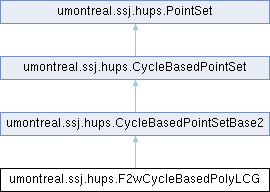
This class creates a point set based upon a linear congruential sequence in the finite field \(\mathbb F_{2^w}[z]/P(z)\). More...
Public Member Functions | |
| F2wCycleBasedPolyLCG (int w, int r, int modQ, int step, int nbcoeff, int coeff[], int nocoeff[]) | |
| Constructs a point set with \(2^{rw}\) points. | |
| F2wCycleBasedPolyLCG (String filename, int no) | |
| Constructs a point set after reading its parameters from file filename; the parameters are located at line numbered no of filename. | |
| String | toString () |
| Formats a string that contains information about the point set. | |
| Public Member Functions inherited from umontreal.ssj.hups.CycleBasedPointSetBase2 | |
| double | getCoordinate (int i, int j) |
| Returns \(u_{i,j}\), the coordinate \(j\) of the point \(i\). | |
| PointSetIterator | iterator () |
| Constructs and returns a point set iterator. | |
| void | addRandomShift (int d1, int d2, RandomStream stream) |
| Adds a random digital shift in base 2 to all the points of the point set, using stream stream to generate the random numbers, for coordinates d1 to d2 - 1. | |
| void | clearRandomShift () |
| Erases the current digital random shift, if any. | |
| String | formatPoints () |
Same as invoking formatPoints(n, d) with \(n\) and \(d\) equal to the number of points and the dimension of this object, respectively. | |
| Public Member Functions inherited from umontreal.ssj.hups.CycleBasedPointSet | |
| int | getDimension () |
| Returns the dimension (number of available coordinates) of the points. | |
| Public Member Functions inherited from umontreal.ssj.hups.PointSet | |
| int | getNumPoints () |
| Returns the number of points. | |
| void | randomize (PointSetRandomization rand) |
| Randomizes this point set using the given rand. | |
| void | addRandomShift (RandomStream stream) |
Same as addRandomShift(0, dim, stream), where dim is the dimension of the point set. | |
| void | addRandomShift (int d1, int d2) |
| Refreshes the random shift (generates new uniform values for the random shift coordinates) for coordinates d1 to d2-1, using the saved shiftStream. | |
| void | addRandomShift () |
Same as addRandomShift(0, dim), where dim is the dimension of the point set. | |
| String | formatPoints (int n, int d) |
| Formats a string that displays the same information as returned by toString, together with the first \(d\) coordinates of the first. | |
| String | formatPoints (PointSetIterator iter) |
Same as invoking formatPoints(iter, n, d) with \(n\) and \(d\) equal to the number of points and the dimension, respectively. | |
| String | formatPoints (PointSetIterator iter, int n, int d) |
Same as invoking formatPoints(n, d), but prints the points by calling iter repeatedly. | |
| String | formatPointsBase (int b) |
Similar to formatPoints(), but the points coordinates are printed in base \(b\). | |
| String | formatPointsBase (int n, int d, int b) |
Similar to formatPoints(n, d), but the points coordinates are printed in base \(b\). | |
| String | formatPointsBase (PointSetIterator iter, int b) |
Similar to formatPoints(iter), but the points coordinates are printed in base. | |
| String | formatPointsBase (PointSetIterator iter, int n, int d, int b) |
Similar to formatPoints(iter,
n, d), but the points coordinates are printed in base \(b\). | |
| String | formatPointsNumbered () |
Same as invoking formatPointsNumbered(n, d) with \(n\) and \(d\) equal to the number of points and the dimension, respectively. | |
| String | formatPointsNumbered (int n, int d) |
Same as invoking formatPoints(n,d), except that the points are numbered. | |
Additional Inherited Members | |
| Static Public Member Functions inherited from umontreal.ssj.hups.PointSet | |
| static int | getMaxBits () |
| Returns the maximum number of usable bits. | |
| Protected Member Functions inherited from umontreal.ssj.hups.CycleBasedPointSet | |
| void | addCycle (AbstractList c) |
| Adds the cycle c to the list of all cycles. | |
| Protected Attributes inherited from umontreal.ssj.hups.PointSet | |
| double | EpsilonHalf = 1.0 / Num.TWOEXP[55] |
| To avoid 0 for nextCoordinate when random shifting, we add this to each coordinate. | |
| int | dim = 0 |
| Dimension of the points. | |
| int | numPoints = 0 |
| Number of points. | |
| int | dimShift = 0 |
| Current dimension of the shift. | |
| int | capacityShift = 0 |
| Number of array elements in the shift vector, always >= dimShift. | |
| double[] | shift |
| This is the shift vector as a double[] array, which contains the current random shift in case we apply a random shift modulo 1. | |
| RandomStream | shiftStream |
| Stream used to generate the random shifts. | |
| Static Protected Attributes inherited from umontreal.ssj.hups.PointSet | |
| static final int | MAXBITS = 31 |
| Since Java has no unsigned type, the 32nd bit cannot be used efficiently, so we have only 31 bits. | |
Detailed Description
This class creates a point set based upon a linear congruential sequence in the finite field \(\mathbb F_{2^w}[z]/P(z)\).
The recurrence is
\[ q_n(z) = z^s q_{n-1}(z) \mod P(z) \]
where \(P(z)\in\mathbb F_{2^w}[z]\) has degree \(r\) and \(q_n(z) = q_{n,1} z^{r-1} + \cdots+ q_{n,r} \in\mathbb F_{2^w}[z]/P(z)\). The parameter \(s\) is called the stepping parameter of the recurrence. The polynomial \(P(z)\) is not necessarily the characteristic polynomial of this recurrence, but it can still be used to store the parameters of the recurrence. In the implementation, it is stored in an object of the class
umontreal.ssj.hups.F2wStructure. See the description of this class for more details on how the polynomial is stored.
Let \(\mathbf{x} = (x^{(0)}, …, x^{(p-1)}) \in\mathbb F_2^p\) be a \(p\)-bit vector. Let us define the function \(\phi(\mathbf{x}) = \sum_{i=1}^p 2^{-i} x^{(i-1)}\). The point set in \(t\) dimensions produced by this class is
\[ \{ (\phi(\mathbf{y}_0),\phi(\mathbf{y}_1),…,\phi(\mathbf{y}_{t-1}): (\mathbf{q}_{0,1},…,\mathbf{q}_{0,r-1})\in\mathbb F_2^{rw}\} \]
where \(\mathbf{y}_n = (\mathbf{q}_{n,1},…,\mathbf{q}_{n,r})\), \(\mathbf{q}_{n,i}\) is the representation of \(q_{n,i}\) under the polynomial basis of \(\mathbb F_{2^w}\) over \(\mathbb F_2\).
Definition at line 61 of file F2wCycleBasedPolyLCG.java.
Constructor & Destructor Documentation
◆ F2wCycleBasedPolyLCG() [1/2]
| umontreal.ssj.hups.F2wCycleBasedPolyLCG.F2wCycleBasedPolyLCG | ( | int | w, |
| int | r, | ||
| int | modQ, | ||
| int | step, | ||
| int | nbcoeff, | ||
| int | coeff[], | ||
| int | nocoeff[] ) |
Constructs a point set with \(2^{rw}\) points.
See the description of the class umontreal.ssj.hups.F2wStructure for the meaning of the parameters. Constructs and stores the set of cycles for an LCG with modulus n and multiplier a. If pgcd(a, n) = 1, this constructs a full-period LCG which has two cycles, one containing 0 and one, the LCG period.
- Parameters
-
n required number of points and modulo of the LCG a generator a of the LCG
Definition at line 69 of file F2wCycleBasedPolyLCG.java.
◆ F2wCycleBasedPolyLCG() [2/2]
| umontreal.ssj.hups.F2wCycleBasedPolyLCG.F2wCycleBasedPolyLCG | ( | String | filename, |
| int | no ) |
Constructs a point set after reading its parameters from file filename; the parameters are located at line numbered no of filename.
The available files are listed in the description of class umontreal.ssj.hups.F2wStructure.
Definition at line 97 of file F2wCycleBasedPolyLCG.java.
Member Function Documentation
◆ toString()
| String umontreal.ssj.hups.F2wCycleBasedPolyLCG.toString | ( | ) |
Formats a string that contains information about the point set.
- Returns
- string representation of the point set information
Reimplemented from umontreal.ssj.hups.CycleBasedPointSet.
Definition at line 104 of file F2wCycleBasedPolyLCG.java.
The documentation for this class was generated from the following file:
- src/main/java/umontreal/ssj/hups/F2wCycleBasedPolyLCG.java