This class implements vectors of bits and the operations needed to use them. More...
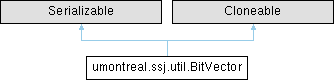
Public Member Functions | |
| BitVector (int length) | |
| Creates a new BitVector of length length with all its bits set to 0. | |
| BitVector (int[] vect, int length) | |
| Creates a new BitVector of length length using the data in vect. | |
| BitVector (int[] vect) | |
| Creates a new BitVector using the data in vect. | |
| BitVector (BitVector that) | |
| Creates a copy of the BitVector that. | |
| Object | clone () |
| Creates a copy of the BitVector. | |
| boolean | equals (BitVector that) |
| Verifies if two BitVector’s have the same length and the same data. | |
| int | size () |
| Returns the length of the BitVector. | |
| void | enlarge (int size, boolean filling) |
| Resizes the BitVector so that its length is equal to size. | |
| void | enlarge (int size) |
| Resizes the BitVector so that its length is equal to size. | |
| boolean | getBool (int pos) |
| Gives the value of the bit in position pos. | |
| void | setBool (int pos, boolean value) |
| Sets the value of the bit in position pos. | |
| int | getInt (int pos) |
| Returns an int containing all the bits in the interval. | |
| String | toString () |
| Returns a string containing all the bits of the BitVector, starting with the highest order bit and finishing with the lowest order bit. | |
| BitVector | not () |
| Returns a BitVector which is the result of the not operator on the current BitVector. | |
| BitVector | selfNot () |
| Applies the not operator on the current BitVector and returns it. | |
| BitVector | xor (BitVector that) |
| Returns a BitVector which is the result of the xor operator applied on this and that. | |
| BitVector | selfXor (BitVector that) |
| Applies the xor operator on this with that. | |
| BitVector | and (BitVector that) |
| Returns a BitVector which is the result of the and operator with both the this and that BitVector’s. | |
| BitVector | selfAnd (BitVector that) |
| Applies the and operator on this with that. | |
| BitVector | or (BitVector that) |
| Returns a BitVector which is the result of the or operator with both the this and that BitVector’s. | |
| BitVector | selfOr (BitVector that) |
| Applies the or operator on this with that. | |
| BitVector | shift (int j) |
| Returns a BitVector equal to the original with all the bits shifted j positions to the right if j is positive, and shifted j positions to the left if j is negative. | |
| BitVector | selfShift (int j) |
| Shift all the bits of the current BitVector j positions to the right if j is positive, and j positions to the left if j is negative. | |
| boolean | scalarProduct (BitVector that) |
| Returns the scalar product of two BitVector’s modulo 2. | |
Detailed Description
This class implements vectors of bits and the operations needed to use them.
The vectors can be of arbitrary length. The operations provided are all the binary operations available to the int and long primitive types in Java. In the implementation, the vector is split in blocks of 32 bits and each block is represented as an integer.
All bit operations are present in two forms: a normal form and a self form. The normal form returns a newly created object containing the result, while the self form puts the result in the calling object (this). The return value of the self form is the calling object itself. This is done to allow easier manipulation of the results, making it possible to chain operations.
Definition at line 45 of file BitVector.java.
Constructor & Destructor Documentation
◆ BitVector() [1/4]
| umontreal.ssj.util.BitVector.BitVector | ( | int | length | ) |
Creates a new BitVector of length length with all its bits set to 0.
- Parameters
-
length the length of the BitVector
Definition at line 67 of file BitVector.java.
◆ BitVector() [2/4]
| umontreal.ssj.util.BitVector.BitVector | ( | int[] | vect, |
| int | length ) |
Creates a new BitVector of length length using the data in vect.
Component vect[0] makes the 32 lowest order bits, with vect[1] being the 32 next lowest order bits, and so on. The normal bit order is then used to fill the 32 bits (the first bit is the lowest order bit and the last bit is largest order bit). Note that the sign bit is used as the largest order bit.
- Parameters
-
vect the bits data length the length of the vector
- Exceptions
-
IllegalArgumentException when the length of `vect` is not compatible with the length provided
Definition at line 86 of file BitVector.java.
◆ BitVector() [3/4]
| umontreal.ssj.util.BitVector.BitVector | ( | int[] | vect | ) |
Creates a new BitVector using the data in vect.
The length of the BitVector is always equals to 32 times the length of vect.
- Parameters
-
vect the bits data
Definition at line 105 of file BitVector.java.
◆ BitVector() [4/4]
| umontreal.ssj.util.BitVector.BitVector | ( | BitVector | that | ) |
Creates a copy of the BitVector that.
- Parameters
-
that the BitVector to copy
Definition at line 114 of file BitVector.java.
Member Function Documentation
◆ and()
Returns a BitVector which is the result of the and operator with both the this and that BitVector’s.
The and operator is equivalent to the & operator in Java. Only bits which are set to 1 in both this and that are set to 1 in the result, all the others are set to 0.
- Parameters
-
that the second operand to the and operator
- Returns
- the result of the and operation
Definition at line 359 of file BitVector.java.
◆ clone()
| Object umontreal.ssj.util.BitVector.clone | ( | ) |
Creates a copy of the BitVector.
- Returns
- a deep copy of the BitVector
Definition at line 126 of file BitVector.java.
◆ enlarge() [1/2]
| void umontreal.ssj.util.BitVector.enlarge | ( | int | size | ) |
◆ enlarge() [2/2]
| void umontreal.ssj.util.BitVector.enlarge | ( | int | size, |
| boolean | filling ) |
Resizes the BitVector so that its length is equal to size.
If the BitVector is enlarged, then the newly added bits are given the value 1 if filling is set to true and 0 otherwise.
Definition at line 171 of file BitVector.java.
◆ equals()
| boolean umontreal.ssj.util.BitVector.equals | ( | BitVector | that | ) |
Verifies if two BitVector’s have the same length and the same data.
- Parameters
-
that the other BitVector to compare to
- Returns
- if the two BitVector’s are identiqual
Definition at line 145 of file BitVector.java.
◆ getBool()
| boolean umontreal.ssj.util.BitVector.getBool | ( | int | pos | ) |
Gives the value of the bit in position pos.
If the value is 1, returns true; otherwise, returns false.
- Parameters
-
pos the position of the checked bit
- Returns
- the value of the bit as a boolean
- Exceptions
-
ArrayIndexOutOfBoundsException if `pos` is outside the range of the BitVector
Definition at line 211 of file BitVector.java.
◆ getInt()
| int umontreal.ssj.util.BitVector.getInt | ( | int | pos | ) |
Returns an int containing all the bits in the interval.
\([\mathtt{pos} \times32, \mathtt{pos} \times32 + 31]\).
- Parameters
-
pos the selected position
- Returns
- the int at the specified position
- Exceptions
-
ArrayIndexOutOfBoundsException if `pos` is outside the range of the BitVector
Definition at line 245 of file BitVector.java.
◆ not()
| BitVector umontreal.ssj.util.BitVector.not | ( | ) |
Returns a BitVector which is the result of the not operator on the current BitVector.
The not operator is equivalent to the ~ operator in Java and thus swap all bits (bits previously set to 0 become 1 and bits previously set to 1 become 0).
- Returns
- the effect of the not operator
Definition at line 276 of file BitVector.java.
◆ or()
Returns a BitVector which is the result of the or operator with both the this and that BitVector’s.
The or operator is equivalent to the | operator in Java. Only bits which are set to 0 in both this and that are set to to 0 in the result, all the others are set to 1.
- Parameters
-
that the second operand to the or operator
- Returns
- the result of the or operation
Definition at line 409 of file BitVector.java.
◆ scalarProduct()
| boolean umontreal.ssj.util.BitVector.scalarProduct | ( | BitVector | that | ) |
Returns the scalar product of two BitVector’s modulo 2.
It returns true if there is an odd number of bits with a value of 1 in the result of the and operator applied on this and that, and returns false otherwise.
- Parameters
-
that the other BitVector with which to do the scalar product
- Returns
- the scalar product
Definition at line 549 of file BitVector.java.
◆ selfAnd()
Applies the and operator on this with that.
Stores the result in this and returns it.
- Parameters
-
that the second operand to the and operator
- Returns
- this
Definition at line 386 of file BitVector.java.
◆ selfNot()
| BitVector umontreal.ssj.util.BitVector.selfNot | ( | ) |
Applies the not operator on the current BitVector and returns it.
- Returns
- the BitVector itself
Definition at line 292 of file BitVector.java.
◆ selfOr()
Applies the or operator on this with that.
Stores the result in this and returns it.
- Parameters
-
that the second operand to the or operator
- Returns
- this
Definition at line 434 of file BitVector.java.
◆ selfShift()
| BitVector umontreal.ssj.util.BitVector.selfShift | ( | int | j | ) |
Shift all the bits of the current BitVector j positions to the right if j is positive, and j positions to the left if j is negative.
The new bits that appears to the left or to the rigth are set to 0. Returns this.
- Parameters
-
j the size of the shift
- Returns
- this
Definition at line 499 of file BitVector.java.
◆ selfXor()
Applies the xor operator on this with that.
Stores the result in this and returns it.
- Parameters
-
that the second operand to the xor operator
- Returns
- this
Definition at line 337 of file BitVector.java.
◆ setBool()
| void umontreal.ssj.util.BitVector.setBool | ( | int | pos, |
| boolean | value ) |
Sets the value of the bit in position pos.
If value is equal to true, sets it to 1; otherwise, sets it to 0.
- Parameters
-
pos the position of the bit to modify value the new value of the bit as a boolean
- Exceptions
-
ArrayIndexOutOfBoundsException if `pos` is outside the range of the BitVector
Definition at line 226 of file BitVector.java.
◆ shift()
| BitVector umontreal.ssj.util.BitVector.shift | ( | int | j | ) |
Returns a BitVector equal to the original with all the bits shifted j positions to the right if j is positive, and shifted j positions to the left if j is negative.
The new bits that appears to the left or to the right are set to 0. If j is positive, this operation is equivalent to the >>> operator in Java, otherwise, it is equivalent to the << operator.
- Parameters
-
j the size of the shift
- Returns
- the shifted BitVector
Definition at line 457 of file BitVector.java.
◆ size()
| int umontreal.ssj.util.BitVector.size | ( | ) |
Returns the length of the BitVector.
- Returns
- the length of the BitVector
Definition at line 159 of file BitVector.java.
◆ toString()
| String umontreal.ssj.util.BitVector.toString | ( | ) |
Returns a string containing all the bits of the BitVector, starting with the highest order bit and finishing with the lowest order bit.
The bits are grouped by groups of 8 bits for ease of reading.
- Returns
- all the bits of the BitVector
Definition at line 258 of file BitVector.java.
◆ xor()
Returns a BitVector which is the result of the xor operator applied on this and that.
The xor operator is equivalent to the ^ operator in Java. All bits which were set to 0 in one of the vector and to 1 in the other vector are set to 1. The others are set to 0. This is equivalent to the addition in modulo 2 arithmetic.
- Parameters
-
that the second operand to the xor operator
- Returns
- the result of the xor operation
Definition at line 312 of file BitVector.java.
The documentation for this class was generated from the following file:
- src/main/java/umontreal/ssj/util/BitVector.java