This abstract class provides event scheduling tools. More...
Public Member Functions | |
| Event () | |
| Constructs a new event instance, which can be placed afterwards into the event list of the default simulator by calling one of the schedule... variants. | |
| Event (Simulator sim) | |
| Construct a new event instance associated with the given simulator. | |
| void | schedule (double delay) |
| Schedules this event to happen in delay time units, i.e., at time sim.time() + delay, by inserting it in the event list. | |
| void | scheduleNext () |
| Schedules this event as the first event in the event list, to be executed at the current time (as the next event). | |
| void | scheduleBefore (Event other) |
| Schedules this event to happen just before, and at the same time, as the event other. | |
| void | scheduleAfter (Event other) |
| Schedules this event to happen just after, and at the same time, as the event other. | |
| void | reschedule (double delay) |
| Cancels this event and reschedules it to happen in delay time units. | |
| boolean | cancel () |
| Cancels this event before it occurs. | |
| final boolean | cancel (String type) |
| Finds the first occurence of an event of class "type" in the event list, and cancels it. | |
| final Simulator | simulator () |
| Returns the simulator linked to this event. | |
| final void | setSimulator (Simulator sim) |
| Sets the simulator associated with this event to sim. | |
| final double | time () |
| Returns the (planned) time of occurence of this event. | |
| final void | setTime (double time) |
| Sets the (planned) time of occurence of this event to time. | |
| final double | priority () |
| Returns the priority of this event. | |
| final void | setPriority (double priority) |
| Sets the priority of this event to inPriority. | |
| int | compareTo (Event e) |
| Compares this object with the specified object e for order. | |
| abstract void | actions () |
| This is the method that is executed when this event occurs. | |
Detailed Description
This abstract class provides event scheduling tools.
Each type of event should be defined as a subclass of the class Event, and should provide an implementation of the method actions which is executed when an event of this type occurs. The instances of these subclasses are the actual events.
Each event is linked to a simulator represented by an instance of
Simulator before it can be scheduled and processed. A default simulator, given by Simulator.getDefaultSimulator, is used if no simulator is linked explicitly with an event. When an event is constructed, it is not scheduled. It must be scheduled separately by calling one of the scheduling methods schedule, scheduleNext, scheduleBefore, etc. An event can also be cancelled before it occurs.
A scheduled event has an associated time at which it will happen and a priority, which can be queried using the methods time and priority, respectively. By default, events occur in ascending order of time, and have priority 1. Events with the same time occur in ascending order of priority. For example, if events e1 and e2 occur at the same time with priority 2 and 1 respectively, then e2 will occur before e1. Events with the same time and priority occur in the order they were scheduled.
Definition at line 53 of file Event.java.
Constructor & Destructor Documentation
◆ Event() [1/2]
| umontreal.ssj.simevents.Event.Event | ( | ) |
Constructs a new event instance, which can be placed afterwards into the event list of the default simulator by calling one of the schedule... variants.
For example, if Bang is an Event subclass, the statement "<tt>new Bang().scheduleNext();</tt>" creates a new Bang event and places it at the beginning of the event list.
Constructs a new event and inserts it in the event list of the default simulator. If delay >= 0.0, the event is scheduled to happen in delay units of simutated time. If two or more events are scheduled to happen at the same time, events with the highest priorities (lowest value of the priority field) occur first. If two or more events are schedule to the same time, with the same priority, they are placed in the event list (and executed) in the same order as they have been scheduled.
We recall that such constructors with parameters are not inherited automatically by the subclasses in Java, but they can be invoked using super. For example, one can have
and then invoke the constructor "<tt>new Bang (10.0)</tt>" to get a Bang in 10 units of time. This is equivalent to "<tt>new Bang().schedule(10.0)</tt>."
- Parameters
-
delay simulation time that must pass before the event happens
Definition at line 126 of file Event.java.
◆ Event() [2/2]
| umontreal.ssj.simevents.Event.Event | ( | Simulator | sim | ) |
Construct a new event instance associated with the given simulator.
Definition at line 135 of file Event.java.
Member Function Documentation
◆ actions()
|
abstract |
This is the method that is executed when this event occurs.
Every subclass of Event that is to be instantiated must provide an implementation of this method.
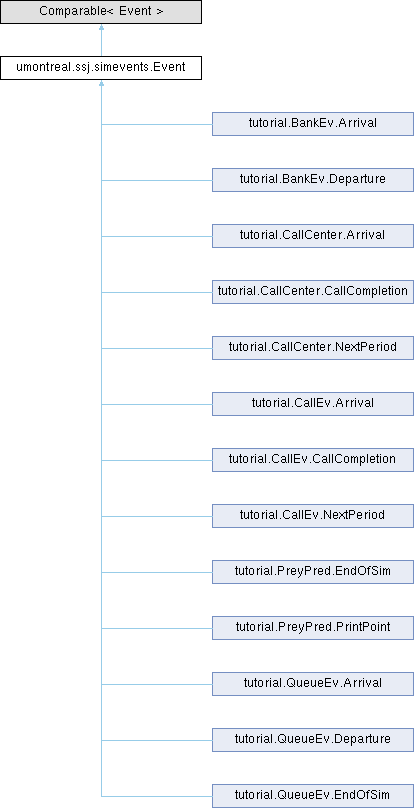
Reimplemented in tutorial.BankEv.Arrival, tutorial.BankEv.Departure, tutorial.CallCenter.Arrival, tutorial.CallCenter.CallCompletion, tutorial.CallCenter.NextPeriod, tutorial.CallEv.Arrival, tutorial.CallEv.CallCompletion, tutorial.CallEv.NextPeriod, tutorial.PreyPred.EndOfSim, tutorial.PreyPred.PrintPoint, tutorial.QueueEv.Arrival, tutorial.QueueEv.Departure, and tutorial.QueueEv.EndOfSim.
◆ cancel() [1/2]
| boolean umontreal.ssj.simevents.Event.cancel | ( | ) |
Cancels this event before it occurs.
Returns true if cancellation succeeds (this event was found in the event list), false otherwise.
- Returns
- true if the event could be cancelled
Definition at line 231 of file Event.java.
◆ cancel() [2/2]
| final boolean umontreal.ssj.simevents.Event.cancel | ( | String | type | ) |
Finds the first occurence of an event of class "type" in the event list, and cancels it.
Returns true if cancellation succeeds, false otherwise.
- Parameters
-
type name of an event subclass
- Returns
- true if an event of this class was found and cancelled
Definition at line 246 of file Event.java.
◆ compareTo()
| int umontreal.ssj.simevents.Event.compareTo | ( | Event | e | ) |
Compares this object with the specified object e for order.
Returns \(-1\) or \(+1\) as this event occurs before or after the specified event e, respectively. If the two events occur at the same time, then returns \(-1\), \(0\), or \(+1\) as this event has a smaller, equal, or larger priority than event e.
Definition at line 325 of file Event.java.
◆ priority()
| final double umontreal.ssj.simevents.Event.priority | ( | ) |
Returns the priority of this event.
- Returns
- the priority of the event
Definition at line 301 of file Event.java.
◆ reschedule()
| void umontreal.ssj.simevents.Event.reschedule | ( | double | delay | ) |
Cancels this event and reschedules it to happen in delay time units.
- Parameters
-
delay simulation time units that must elapse before the event happens
Definition at line 215 of file Event.java.
◆ schedule()
| void umontreal.ssj.simevents.Event.schedule | ( | double | delay | ) |
Schedules this event to happen in delay time units, i.e., at time sim.time() + delay, by inserting it in the event list.
When two or more events are scheduled to happen at the same time and with the same priority, they are placed in the event list (and executed) in the same order as they have been scheduled. Note that the priority of this event should be adjusted using setPriority before it is scheduled.
- Parameters
-
delay simulation time that must pass before the event happens
Definition at line 153 of file Event.java.
◆ scheduleAfter()
| void umontreal.ssj.simevents.Event.scheduleAfter | ( | Event | other | ) |
Schedules this event to happen just after, and at the same time, as the event other.
- Parameters
-
other event after which this event will be scheduled
Definition at line 202 of file Event.java.
◆ scheduleBefore()
| void umontreal.ssj.simevents.Event.scheduleBefore | ( | Event | other | ) |
Schedules this event to happen just before, and at the same time, as the event other.
For example, if Bing and Bang are Event subclasses, after the statements
the event list contains two new events scheduled to happen in 12 units of time: a Bing event, followed by a Bang called bigOne.
- Parameters
-
other event before which this event will be scheduled
Definition at line 188 of file Event.java.
◆ scheduleNext()
| void umontreal.ssj.simevents.Event.scheduleNext | ( | ) |
Schedules this event as the first event in the event list, to be executed at the current time (as the next event).
Definition at line 166 of file Event.java.
◆ setPriority()
| final void umontreal.ssj.simevents.Event.setPriority | ( | double | priority | ) |
Sets the priority of this event to inPriority.
This method should never be called after the event was scheduled, otherwise the events would not execute in ascending priority order anymore.
- Parameters
-
priority new priority for the event
Definition at line 312 of file Event.java.
◆ setSimulator()
| final void umontreal.ssj.simevents.Event.setSimulator | ( | Simulator | sim | ) |
Sets the simulator associated with this event to sim.
This method should not be called while this event is in an event list.
- Parameters
-
sim the Simulator
Definition at line 266 of file Event.java.
◆ setTime()
| final void umontreal.ssj.simevents.Event.setTime | ( | double | time | ) |
Sets the (planned) time of occurence of this event to time.
This method should never be called after the event was scheduled, otherwise the events would not execute in ascending time order anymore.
- Parameters
-
time new time of occurence for the event
Definition at line 290 of file Event.java.
◆ simulator()
| final Simulator umontreal.ssj.simevents.Event.simulator | ( | ) |
Returns the simulator linked to this event.
- Returns
- the simulator linked to the event
Definition at line 256 of file Event.java.
◆ time()
| final double umontreal.ssj.simevents.Event.time | ( | ) |
Returns the (planned) time of occurence of this event.
- Returns
- the time of occurence of the event
Definition at line 279 of file Event.java.
The documentation for this class was generated from the following file:
- src/main/java/umontreal/ssj/simevents/Event.java