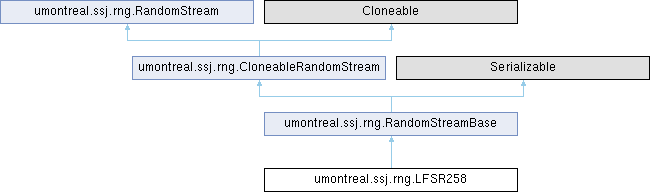
Extends RandomStreamBase using a 64-bit composite linear feedback shift register (LFSR) (or Tausworthe) RNG as defined in [144],. More...
Public Member Functions | |
| LFSR258 () | |
| Constructs a new stream. | |
| LFSR258 (String name) | |
| Constructs a new stream with the identifier name. | |
| void | setSeed (long seed[]) |
| This method is discouraged for normal use. | |
| long[] | getState () |
| Returns the current state of the stream, represented as an array of five integers. | |
| LFSR258 | clone () |
| Clones the current generator and return its copy. | |
| void | resetStartStream () |
| Reinitializes the stream to its initial state \(I_g\): \(C_g\) and \(B_g\) are set to \(I_g\). | |
| void | resetStartSubstream () |
| Reinitializes the stream to the beginning of its current substream: | |
| void | resetNextSubstream () |
| Reinitializes the stream to the beginning of its next substream: | |
| String | toString () |
| Returns a string containing the current state of this stream. | |
| int | nextInt (int i, int j) |
| Calls nextDouble once to create one integer between i and j. | |
| Public Member Functions inherited from umontreal.ssj.rng.RandomStreamBase | |
| void | increasedPrecision (boolean incp) |
| After calling this method with incp = true, each call to the RNG (direct or indirect) for this stream will return a uniform random number with more bits of precision than what is returned by nextValue, and will advance the state of the stream by 2 steps instead of 1 (i.e., nextValue will be called twice for each random number). | |
| double | nextDouble () |
| Returns a uniform random number between 0 and 1 from the stream. | |
| void | nextArrayOfDouble (double[] u, int start, int n) |
| Calls nextDouble n times to fill the array u. | |
| void | nextArrayOfInt (int i, int j, int[] u, int start, int n) |
| Calls nextInt n times to fill the array u. | |
| String | formatState () |
| Use the toString method. | |
| String | formatStateFull () |
| Use the toStringFull method. | |
Static Public Member Functions | |
| static void | setPackageSeed (long seed[]) |
| Sets the initial seed for the class LFSR258 to the five integers of array seed[0..4]. | |
Protected Member Functions | |
| double | nextValue () |
| This method should return the next random number (between 0 and 1) from the current stream. | |
Detailed Description
Extends RandomStreamBase using a 64-bit composite linear feedback shift register (LFSR) (or Tausworthe) RNG as defined in [144],.
[220] . This generator is the LFSR258 proposed in [146] . It has five components combined by a bitwise xor. Its period length is \(\rho\approx2^{258}\). The values of \(V\), \(W\) and \(Z\) are \(2^{100}\), \(2^{100}\) and \(2^{200}\) respectively (see RandomStream for their definition). The seed of the RNG, and the state of a stream at any given step, are five-dimensional vectors of 64-bit integers. The default initial seed [1] of the RNG is (123456789123456789, 123456789123456789, 123456789123456789, 123456789123456789, 123456789123456789). The nextValue method returns numbers with 53 bits of precision. This generator is fast for 64-bit machines.
Definition at line 53 of file LFSR258.java.
Constructor & Destructor Documentation
◆ LFSR258() [1/2]
| umontreal.ssj.rng.LFSR258.LFSR258 | ( | ) |
Constructs a new stream.
Definition at line 77 of file LFSR258.java.
◆ LFSR258() [2/2]
| umontreal.ssj.rng.LFSR258.LFSR258 | ( | String | name | ) |
Constructs a new stream with the identifier name.
- Parameters
-
name name of the stream
Definition at line 146 of file LFSR258.java.
Member Function Documentation
◆ clone()
| LFSR258 umontreal.ssj.rng.LFSR258.clone | ( | ) |
Clones the current generator and return its copy.
- Returns
- A deep copy of the current generator
Reimplemented from umontreal.ssj.rng.RandomStreamBase.
Definition at line 213 of file LFSR258.java.
◆ getState()
| long[] umontreal.ssj.rng.LFSR258.getState | ( | ) |
Returns the current state of the stream, represented as an array of five integers.
- Returns
- the current state of the stream
Definition at line 204 of file LFSR258.java.
◆ nextInt()
| int umontreal.ssj.rng.LFSR258.nextInt | ( | int | i, |
| int | j ) |
Calls nextDouble once to create one integer between i and j.
This method always uses the highest order bits of the random number. It should be overridden if a faster implementation exists for the specific generator.
- Parameters
-
i the smallest possible returned integer j the largest possible returned integer
- Returns
- a random integer between i and j
Reimplemented from umontreal.ssj.rng.RandomStreamBase.
Definition at line 330 of file LFSR258.java.
◆ nextValue()
|
protected |
This method should return the next random number (between 0 and 1) from the current stream.
If the stream is set to the high precision mode (increasedPrecision(true) was called), then each call to nextDouble will call nextValue twice, otherwise it will call it only once.
- Returns
- a number in the interval (0,1)
Reimplemented from umontreal.ssj.rng.RandomStreamBase.
Definition at line 321 of file LFSR258.java.
◆ resetNextSubstream()
| void umontreal.ssj.rng.LFSR258.resetNextSubstream | ( | ) |
Reinitializes the stream to the beginning of its next substream:
\(N_g\) is computed, and \(C_g\) and \(B_g\) are set to \(N_g\).
Reimplemented from umontreal.ssj.rng.RandomStreamBase.
Definition at line 239 of file LFSR258.java.
◆ resetStartStream()
| void umontreal.ssj.rng.LFSR258.resetStartStream | ( | ) |
Reinitializes the stream to its initial state \(I_g\): \(C_g\) and \(B_g\) are set to \(I_g\).
Reimplemented from umontreal.ssj.rng.RandomStreamBase.
Definition at line 225 of file LFSR258.java.
◆ resetStartSubstream()
| void umontreal.ssj.rng.LFSR258.resetStartSubstream | ( | ) |
Reinitializes the stream to the beginning of its current substream:
\(C_g\) is set to \(B_g\).
Reimplemented from umontreal.ssj.rng.RandomStreamBase.
Definition at line 231 of file LFSR258.java.
◆ setPackageSeed()
|
static |
Sets the initial seed for the class LFSR258 to the five integers of array seed[0..4].
This will be the initial state of the next created stream. The default seed [2] for the first stream is (123456789123456789, 123456789123456789, 123456789123456789, 123456789123456789, 123456789123456789). The first, second, third, fourth and fifth integers of seed must be either negative, or greater than or equal to 2, 512, 4096, 131072 and 8388608 respectively.
- Parameters
-
seed array of 5 elements representing the seed
Definition at line 164 of file LFSR258.java.
◆ setSeed()
| void umontreal.ssj.rng.LFSR258.setSeed | ( | long | seed[] | ) |
This method is discouraged for normal use.
Initializes the stream at the beginning of a stream with the initial seed seed[0..4]. The seed must satisfy the same conditions as in setPackageSeed. This method only affects the specified stream; the others are not modified, so the beginning of the streams will not be spaced
\(Z\) values apart. For this reason, this method should only be used in very exceptional cases; proper use of the reset... methods and of the stream constructor is preferable.
- Parameters
-
seed array of 5 elements representing the seed
Definition at line 191 of file LFSR258.java.
◆ toString()
| String umontreal.ssj.rng.LFSR258.toString | ( | ) |
Returns a string containing the current state of this stream.
- Returns
- the state of the generator formated as a string
Reimplemented from umontreal.ssj.rng.RandomStreamBase.
Definition at line 298 of file LFSR258.java.
The documentation for this class was generated from the following file:
- src/main/java/umontreal/ssj/rng/LFSR258.java